Research Article | | Peer-Reviewed

Hydropower Generation Potential of the Pwalugu River of the White Volta River Basin, Ghana

Received: 12 January 2026     Accepted: 21 January 2026     Published: 4 February 2026
Views:       Downloads:
Abstract

Hydropower is one of the most commercially developed renewable energy sources globally. This study assessed the hydropower generation potential of the Pwalugu River section of the White Volta River in Ghana using the depth-averaged shallow-water equations (SWEs) hydrodynamic model. Various topographic models of the seabed were engineered to assess the topographic response to hydrodynamic flow, including the formation of whirlpools. The modelled equations were discretised using the Lax-Wendroff iteration scheme, and Python 3.07 was employed to implement the algorithm. The computed hydropower associated with the flowing fluid showed a significant difference before and after interacting with the engineered bottom-topographic structures. The topographic response to the flow led to increased mass flow rate, instigated by the developed flowing whirlpool, which served as a dynamic energy storage system for the flow channel. The topographic model with two mounts arranged along the river channel could produce power within the range of 1.8 MW - 2.9 MW. These were observed at locations x = 240 m, x = 481 m, and x = 962 m from the source of disturbances. The study, therefore, showed that the Pwalugu River section of White Volta River has the potential of generating hydropower if turbines are sited at these locations to enhance power generation capacity for the electrification of rural communities and the utlisation of the spillage from the Bagre dam in Burkina Faso, which causes perennial flooding in low-lying communities along the White Volta and the Black Volta in Ghana.

Published in Journal of Water Resources and Ocean Science (Volume 15, Issue 1)
DOI 10.11648/j.wros.20261501.13
Page(s) 16-28
Creative Commons

This is an Open Access article, distributed under the terms of the Creative Commons Attribution 4.0 International License (http://creativecommons.org/licenses/by/4.0/), which permits unrestricted use, distribution and reproduction in any medium or format, provided the original work is properly cited.

Copyright

Copyright © The Author(s), 2026. Published by Science Publishing Group

Keywords

Hydropower, Lax-Wendroff Scheme, Shallow Water Equation, Topographic Model, White Volta River

1. Introduction
The recognition of the significance of hydropower has gained increasing importance on a global scale. This is due to its sustainability and the rapid depletion of traditional sources of electricity, such as fossil fuels and coal . The expected increase in electricity demand by 2035 is stipulated at seventy per cent (70%), with half a billion people in Africa alone not having access to electricity . Estimating the global population of people to be at eight (8) billion by 2035, along with rapid economic and industrialised growth in developing countries, a shortage in electricity demand could occur if an alternative to the non-renewable sources of the world’s electricity is not sought . The over-dependence on the non-renewable resources (fossil fuel, nuclear, coal and gas) of the world’s electricity is proven unsatisfactory since a large section of the world's people still do not have access to this electricity. The rapid depletion of these non-renewable resources threatens the world’s electricity sustainability and, therefore, the need to turn to renewable resources, including hydropower. In Africa, wood from trees and shrubs is still the most important domestic fuel. The use of petroleum and coal is limited to urban areas, factories and power plants. The continent’s most promising source of power is hydroelectric power due to its vast number of rivers that have not been exploited. In the 1960s, several major installations were constructed; these include the Kpong and Akosomba dams in Ghana. The Akosombo dam (established in 1965) could generate 5.4 billion kilowatt-hours of electricity. Ghana, until the mid-1990s, was a regular exporter of electricity, but low water levels in the Volta Lake have periodically caused power shortages in the country. The world’s population is estimated to reach 8.8 billion people by 2040, and with fossil fuel as its main electricity source, it will be impossible for this non-renewable resource to sustain this overwhelming population. The other factors that call for another source of electricity include: depletion of this non-renewable source, increasing greenhouse effect and increasing oil demand .
Thus, renewable energy alternatives or green sources, which are sustainable, should be more desirable than non-renewable energy sources. Currently, the common forms of renewable energy systems are: solar energy, wind energy, hydro energy, tidal energy, geothermal energy, and biomass energy . Accordingly, Abbasi et al (2022) posit that the sustainable energy needs of the world will become very relevant in the next fifty (50) years, due to the pronounced effects of fossil fuel usage on the environment. Hence, the complications surrounding the integration of renewable energy acquisition need to be looked at intensively. The reliability of the supply while using intermittent sources of electricity, and the ensuing need for storage and backup generation, are necessary factors in high percentage renewable energy systems . A higher level of both small-scale and large-scale deployment of innovative and renewable energy supply technologies will be feasible as these technologies get more affordable and appealing.
Among the renewable energy resources, hydropower is one of the most commercially developed renewable energy sources. It involves building a dam to serve as a huge reservoir, which is used to create a controlled flow of water that can rotate a turbine to produce electricity. Compared to solar or wind energy, this type of energy is more reliable and efficient, and it also allows electricity to be stored for use when demand is at its peak , though the operation of hydropower plants can alter river flows, potentially affecting river ecosystems. According to National Renewable Energy Laboratory (2025) of the US Department of Energy, now renamed National Laboratory of the Rockies, the world’s hydroelectric power plants have a combined capacity of six hundred and seventy-five thousand megawatt (675000 Megawatt (MW)), which produces 2.3 trillion of electricity each year; supplying twenty-four per cent (24%) of the world’s electricity to more than one billion customers. This indicates that hydropower is the world's leading renewable electricity source, providing over 14% of global power, with significant capacity growth driven by Asia and Africa, especially in pumped storage for grid flexibility . In 2024, generation rebounded strongly (around 4,500+ Terawatt-hour (TWh)) after drought impacts, with total installed capacity nearing 1,400 Gigawatt (GW) . While its share of overall growth may slightly shrink due to solar/wind, hydropower remains crucial for grid stability and low-carbon systems, with ongoing development and modernisation efforts in developing countries.
There are three main categories of small hydropower plants: mini (500 kW to 10 MW), micro (10 kW to 500 kW), and pico (less than 10 kW) . Small hydropower cannot be disregarded as a solution to meet some of Africa’s future energy demands because of its ability to serve the energy needs of the dispersed rural population. Small hydropower development often has lower costs than large-scale hydropower production . Several studies on small and mini hydropower sites have been carried out in Ghana. A total small hydropower plant (SHP) potential of Ghana has been estimated to be between 1.2 MW installed capacity for the minimum case and 4 MW installed capacity for the maximum scenario when considering straightforward run-of-river projects, sized to provide electricity for rural communities not connected to the national grid . However, if the SHP could be connected to the national electrical grid, which would absorb the extra energy output, this installed capacity might be greatly improved. In Ghana, there are three hydropower facilities located in Akosombo, Kpong and Bui on the Volta River. The Akosombo plant is upstream and discharges a head downstream to feed the Kpong facility. The Akosombo plant is constructed to function between water levels 75.59 m in the minimum and 84.12 m in the maximum, while the Kpong plant functions between water levels 14.5 m in the minimum scenario and 17.7 m in the maximum . The Akosombo and Kpong dams were established in 1965 and 1982, respectively, with a capacity of 1072 MW and 160 MW, respectively. The Akosombo features six turbine-generators that are normally running between a water head level of 84.12 m and 75.59 m, whereas the Kpong plant comprises four turbine-generator units and operates with a water head elevation of 17.70 m maximum and 14.50 m minimum. The Bui Hydroelectric Power Station is Ghana's third major hydro project, located on the Black Volta River, providing significant clean energy (around 404 MW) to the national grid, bolstering energy security, especially in northern Ghana, and integrating modern tech like solar and battery storage for a hybrid renewable system, making it a key part of Ghana's sustainable energy future.
This study explores the hydroelectric power generation potential of the Pwalugu River section of the White Volta River Basin, using the shallow water equations (SWEs) hydrodynamic model. The White Volta River Basin is a major sub-basin of the Volta River system in West Africa, stretching across Burkina Faso and Ghana, characterised by semi-arid to subhumid zones, crucial for millions of livelihoods, but facing challenges such as flooding due to rainfall and dam releases from the Bagre dam in Burkina Faso, water scarcity, and climate change impacts. Each year, the spillage of the Bagre dam causes flooding in low-lying communities along the White Volta and the Black Volta in Ghana, destroying livelihoods and rendering many residents homeless. The government of Ghana has been exploring options, including constructing dams along the stretch to store excess water for irrigation and boost food production. This study contributes to the options available to utilise the spillage of the Bagre dam to avert flooding in Ghana and reduce possible tension between Ghana and Burkina Faso.
2. Materials and Methods
2.1. Formulation of Hydrodynamic Model
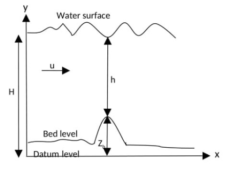
The mathematical model employed for the potential hydroelectric power generation from the White Volta River is based on the shallow water equations. The Shallow Water Equations (SWEs) are a set of simplified partial differential equations (PDEs) describing fluid flow where the horizontal scale is much larger than the vertical depth, used for oceans, rivers, and atmospheres, modelling tides, tsunamis, and storm surges by conserving mass and momentum, representing fluid height (h) and average velocity (u) . They arise from depth-averaging the Navier-Stokes equations, assuming hydrostatic balance (i.e., negligible vertical acceleration) and constant density, which leads to hyperbolic equations that capture wave propagation and nonlinear effects . Accordingly, the development of large-scale whirlpools (vortices) in water bodies, such as rivers, is due to interactions between the water and submerged objects . In achieving total volume and total momentum conservation of fluid in the flow directions, conservation equations need to be attained for water flux and momentum. The diagrammatic representation of a river channel with irregular bed structure is shown in Figure 1.
Source: adapted from Nosrati et al (2022)

Download: Download full-size image

Figure 1. A Shallow Water Channel with Irregular Bed Topography.
In Figure 1, u is fluid velocity in the flow direction, h is the water depth, z is the channel bottom topography elevation, H is the channel depth along the z-direction. To capture the effect of disturbance caused by submerged structures in fluid flows, and their contribution to hydropower generation, the study modelled the depth-averaged shallow water equations (SWE). According to , the SWEs for fluid flow in a channel with depth h, averaged horizontal and vertical velocities u and v, respectively, are given as:
ht+hux+hvy=0(1)
hut+hu2x+huvy=-ρgh+zbx+1ρhτxxx+1ρhτxyy+τxzs-τxzbρ-fx(2)
hvt+hv2y+huvx=-ρgh+zbx+1ρhτyyy+1ρhτyxy+τxzs-τxzbρ-fy(3)
Where the bed elevation is z(x y). The fx and fy are depth-averaged Coriolis force components, and g is the acceleration due to gravity. The mathematical expressions, for τxx, τyy and τxy, τyx the depth-averaged components of the viscous stresses. The Reynolds stress tensors are:
τxx=2ρυ+υtux(4)
τyy=2ρυ+υtvy(5)
τxy=τyx=2ρυ+υtuy+vx(6)
The wind stresses and bottom friction in the flow directions are respectively denoted by (τxz)s, (τyz)s and (τxz)b, (τyz)b (Ercan & Kavvas, 2015):
τxzs=ρcfmbuu2+v2(7)
τxzs=ρcfmbvu2+v2(8)
cf=gn2h13(9)
The bed friction in the flow direction is of the Manning form:
τxzb=ρghn2uu2+v22h43(10)
τyzb=ρghn2vu2+v22h43(11)
The parameters of the above equations are designated as: mbbeing the bed slope coefficient, n being the Manning roughness coefficient, vt the eddy viscosity, h the water height, v the kinematic viscosity and ρ the fluid density. The flow velocities in the x-y directions are represented by u and v. When fluid interacts with bottom topographic structures, disturbances are introduced in the fluid around the vicinity of the topographic structure and render equations (2) and (3) inappropriate in predicting fluid behaviour. Therefore, equations (1) - (3) are modified as follows:
ht+hux+hvy=0(12)
hut+u2h+gh22x+huvy+2Ωv=fxzb+fτu+fτus-fvh (13)
hvt+v2h+gh22y+huvx-2Ωu=fyzb+fτv+fτvs-fuh(14)
Where: Ω is the rotation of fluid volume, h is the height of the water in the channel, u, v are the velocities in the x-y directions of the flow. The shear stress terms are defined as:
fτu= 1ρhτxxx+1ρhτxyyandfτv=1ρhτyyy+1ρhτyxy(15)
The bottom shear stresses in the flow directions are designated as:
fxzb=-ghzbyandfyzb=-ghzby(16)
And lastly, the surface stresses;
fτus=τxzsρ(17)
The preceding equations (1) - (3) can be cast into a form appropriate for application of the numerical scheme. Thus,
thhuhv+xhuhu2+12gh2huv+yhvhv2+12gh2hvu=fxzb+fτu+fτub-2Ωvh-fvhfyzb+fτv+fτvb-2Ωuh-fuh(18)
To solve equations (1) - (3), a finite volume discretisation scheme is employed within the Lax-Wendroff algorithm. The numerical solutions obtained will be analysed in the following sections.
The model of the bottom topography zb, inspected in this study, is the double mount placed at the channel entrance, channel middle and end of a 1km long channel. The double bottom mount is modelled as:
Zb=ZO1e-x-xo1Lx2-y-yoLy2+ZO2e-x-xo2Lx2-y-yoLy2(19)
Where x01, y01, and x02, y02 are the respective locations of the two bottom mounts.
The following initial conditions are applied:
For the d pth,
h (t = 0, x, y) = H_o (x, y) - z_b (x, y)(20)
for the momentum components,
u (t = 0, x, y) = u_o,(21)
v (t = 0, x, y) = 0,(22)
For the Dirichlet boundary condition on u, a periodic boundary condition on h and a no-slip boundary condition on v at the inlet boundary. Thus;
h (t, x = 0, y) = h (t, x = Lx, y)(23)
u (t, x = 0, y) = u0(24)
v (t, x = 0, y) = 0(25)
For the kinetic boundary condition on u, periodic boundary condition on h and a no-slip boundary condition on v at the outlet boundary. Thus;
h (t, x = Lx, y) = h (t, x = 0, y)(26)
u (t, x = Lx, y) = u (t, x = Lx-1, y)(27)
v (t, x = Lx, y) = 0(28)
2.2. Initial and Boundary Conditions
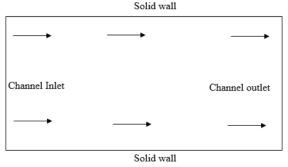
The stimulated domain, indicating the boundaries, is displayed in Figure 2. The computational domain of the channel consists of horizontal walls or river banks, an inlet upstream and an outlet downstream.
Figure 2. Computational Domain of River Channel.
2.2.1. Initial Conditions
The initial conditions for the shallow water equations are:
For the depth,
hx,yn=0=Ho,x,y-zb,x,y(29)
And for the momentum components,
ux,yn=0=uo(30)
ux,yn=0=0(31)
2.2.2. Boundary Conditions: Inlet and Outlet
Fluid constantly flows in and out of the domain. For this reason, one can impose a Dirichlet boundary condition on u, periodic boundary condition on h and a no-slip boundary condition on v at the inlet boundary.
Thus;
hx=0,yn=hx=Lx,yn(32)
ux=0,yn=uo(33)
ux=0,yn=0(34)
Where, Lx is the channel length in meters. For the channel outlet, a kinetic boundary condition is imposed on u, periodic boundary condition on h and no-slip boundary condition on v at the outlet boundary. They are:
hx=Lx,yn=hx=0,yn(35)
ux,y=0n=ux,y=Lyn(36)
ux,y=Lyn=0(37)
Where Ly is the channel width in meters.
2.2.3. Boundary Conditions: River Walls
At the walls (river banks), kinetic boundary conditions are imposed on u and h and no-slip boundary condition imposed on v. That is, at y = 0, y = Ly, hn=un=0, v = 0. Thus;
The discretised form of the solid walls’ boundary conditions is:
hx=Lx,jn=hx=0,jn(38)
ux,jn=uo(39)
ux=Lx,jn=0(40)
2.3. Topographic Models of the River Bed
Bottom topography has significant implications in determining flow fields in oceans and rivers, and is also applied in shallow water waves to assess tsunami waves that originate from underwater earthquakes, which can cause irregular topography and alter water depth . A river that has a flat bottom and a river that has single and double mountains placed along flow paths are modelled, and their corresponding effects on flow patterns are presented in the next section. The combined nature of the seabed and water surface constitutes the topography of a channel. The variation of river bottom topography has a significant influence on fluid flow patterns and therefore requires a deeper understanding to ensure proper flow behaviour analysis. The preceding section presents various river bottom topographies and how they vary the flow pattern. In all the models, the water surface was assumed to be rippled. A simple sinusoidal function can describe such a ripple surface:
H = HO-sin2πxLx(41)
2.3.1. Flat Bottom Model
The model for a river channel with a flat bottom can be modelled as:
zb(x; y) = constant(42)
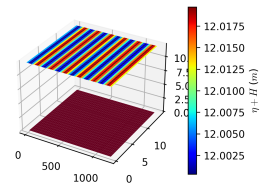
A typical graphical view of flat bottom topography for constant = 0, and the water surface is shown in Figure 3.
Figure 3. 3D flow pattern along a flat-bottom channel due to waves.
2.3.2. Single Mountain Along Flow Path
The bottom topography of a river with a single mountain can be modelled using the Gaussian expression:
Zb=ZO1e-x-xo1Lx2-y-yoLy2+ZO2e-x-xo2Lx2-y-yoLy2(43)
Where x0,y0 are the coordinates of the location of the obstacle centre.
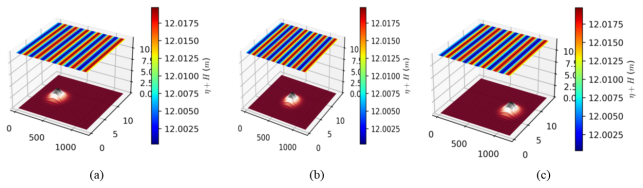
A graphical view of the single mountain model is shown in Figure 4. The mountain was placed at three different locations: left, middle and right of the channel.
Figure 4. Locations of the bottom mountain at (a) channel entrance, (b) channel middle, (c) channel extreme.
2.3.3. Two Mountains Along the Flow Path
The bottom topography of a river with two mountains arranged along the flow path is modelled by the equation:
Zb=ZO1e-x-xo1Lx2-y-yoLy2+ZO2e-x-xo2Lx2-y-yoLy2(44)
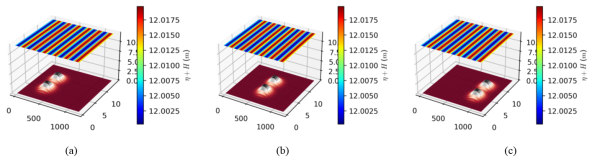
Where x01, y01, and x02, y02 are the respective locations of the two bottom mounts. The graphical view of two mountains at three different locations in the river channel is displayed in Figure 5: the entrance, middle and end of the channel.
Figure 5. Location of the double bottom mountains model at (a) channel entrance, (b) channel middle, (c) channel end.
3. Results and Discussion
3.1. Model Validation
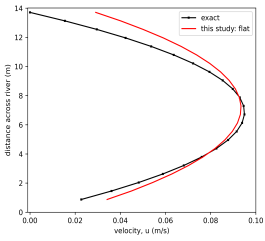
To proceed with analysing the results obtained in this study, it was essential to verify the accuracy of the results. Thus, a validation of the results was conducted by applying the flat-bottom model case to the analytical solution derived from Equations (2) and (3), under simplified assumptions.
That is, considering only steady and horizontal flows in the flat channel, the equation becomes:
2uy2=-1μp(45)
The analytical solution is straightforward upon integrating across the river channel, as:
u(y)=uoy-H2(46)
Where uo depends on the pressure gradient, p and viscosity, μ. The graph of the solution of equation (45), which is in agreement with the stimulated flat case model, is displayed in Figure 6.
Figure 6. Comparison of the flow profile in an ideal channel with the model.
3.2. Hydrodynamic Response and Flow Curves
It was imperative to study the dynamic behaviour of the water elevation, h and the flow rate, Q or the velocity of the flow, u. This served as a precursor for the identification of potential locations where maximum power can be obtained. Thus, the hydropower generation potential of the Pwalugu River section of White Volta was modelled.
3.2.1. Hydrokinetic Power and Energy Analysis
The power that can be assessed from a flowing stream is calculated theoretically as:
P = ρgQh(47)
Where g is acceleration due to gravity, Q=lBhu is discharge and h is the water surface elevation. Depending on the type of hydropower generating system, the elevation, h is defined differently. In the run-of-river, as is the study case, the elevation is defined as: h=ho+h. The fluctuation is caused by the bottom topography. In analogy with the total energy stored in the system. The power in equation (43) can be cast into components: P = PO + PDynamic.
Where P is the power due to the elevation, and PO is associated with the power stored in the dynamic system. They are defined as:
PO= ρgQho(48)
And using h=Q22gA, the dynamic power resulting from the disturbance is
PDynamic=ρghQ32gAh=ρu22Q(49)
Thus, the power-generating capacity of the river channel can be obtained from:
P=ρgh+Q22gAQ(50)
The energy associated with power in equation (48) can be obtained using the expression:
EKWh=1Ntt=0NtPh,Qt(51)
Where t is the time scale associated with the operation period. Therefore, equations (49) and (50) were used to assess the potential of the study area.
3.2.2. Average Power and Energy Potential
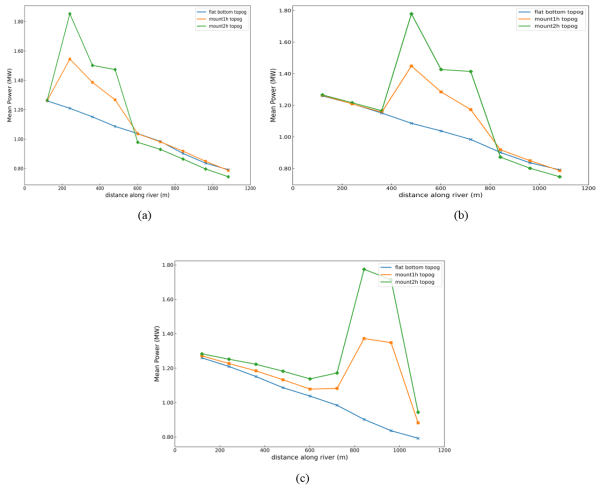
In Figure 7, the mean power is plotted against distance along the river. It is expected that (from Figure 7a - c) the locations of maximum power fluctuations happen to be at the various locations close to the bottom mountains, where there is a high level of perturbation due to fluid-bottom mountain interactions. A maximum power of about 1.8 MW was observed at locations x = 240 m, x = 481 m and x = 962 m, which happen to be in the neighbourhood of the engineered bottom structures. These corresponding power fluctuations at locations of the bottom mountains, as portrayed by Figure 8(a-c), confirm the linearity that exists between energy and power. Hence, installing a turbine at such locations would result in considerable hydropower generation.
Figure 7. Graph of mean power along the river channel due to the bottom mountain at: (a) channel entrance, (b) channel middle, and (c) channel extreme.
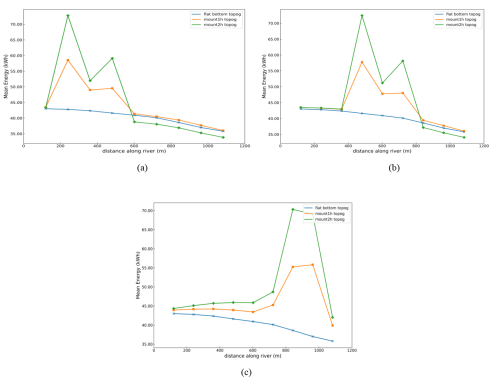
Furthermore, in Figure 8 (a-c), the mean energy is plotted against distance along the river channel. The highest mean energy was observed for 2 bottom mounts in the three locations of the engineered structures: channel entrance, middle and extreme. The highest mean energy realised was about 75 Kilowatt-hour (kWh). A second-highest mean energy of about 60 kWh was released at the locations of the single mounts. The corresponding increase in the energy in the flowing water at the locations of the bottom mountains is an indication of the inculcation of energy-bearing structures in the flowing water due to the interaction between the bottom mountains and the flowing water in the channel.
Figure 8. Graph of mean energy along the river channel due to the bottom mountain at (a) channel entrance, (b) channel middle, (c) channel extreme.
3.2.3. Peak Power and Maximum Energy Potential
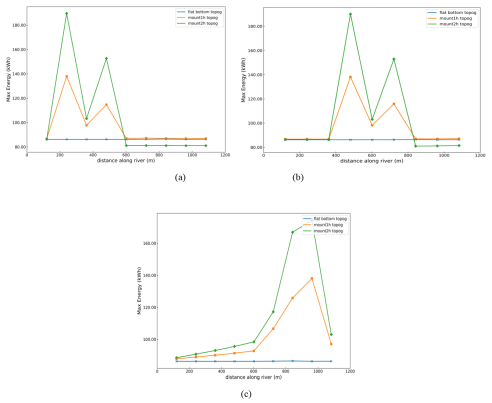
Figure 9. Graph of maximum energy along the river channel due to the bottom mountain at (a) channel entrance, (b) channel middle, (c) channel extreme.
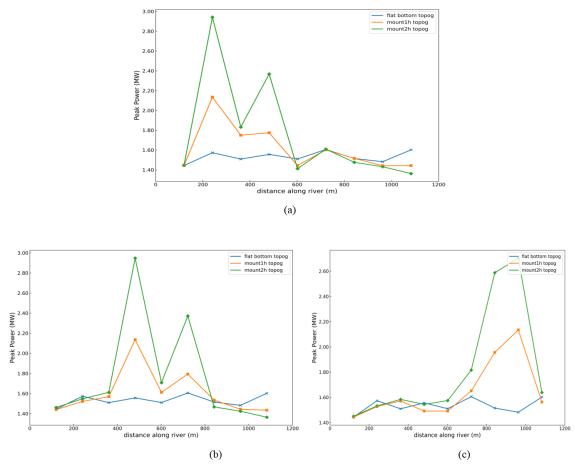
A comparative analysis was conducted on peak power and maximum energy production by various topographies, together with an evaluation of the model performance to ascertain the particular topographic model for optimum power generation. Figures 9 (a-c) and 10 (a-c) display the graphs of maximum energy and peak power at the locations of three topographies along the river channel.
In Figure 9 above, it was evident that the maximum energy in the cases of left, middle and right positioning of engineered structures, the 2 mounts were observed with maximum energy of about 185 kWh for left-oriented 2 mounts, middle-oriented 2 mounts and right-oriented 2 mounts. The second-highest maximum energy of about 140 kWh was produced at the locations of 1 mount. These arrangements, therefore, yielded the highest energy.
Figure 10. Graph of maximum power along the river channel due to the bottom mountain at (a) channel entrance, (b) channel middle, (c) channel extreme.
In Figure 10 above, it is evident that the maximum power in the cases of left, middle, and right positioning of engineered structures was observed with the 2 mounts, with a maximum power of about 2.9 MW for the left-oriented 2 mounts, middle-oriented 2 mounts, and right-oriented 2 mounts. The second-highest maximum power of approximately 2.2 MW was produced at the location of Mount 1. Thus, these arrangements yielded the highest power.
4. Conclusion
The study modelled the hydropower generation potential of the Pwalugu River section of the White Volta River in Ghana, using the depth-averaged SWEs hydrodynamic model. The assessment was undertaken by analysing the average power and energy potential, and peak power and maximum energy potential of the Pwalugu River section of the White Volta River. A maximum power of about 1.8 MW was observed at locations x = 240 m, x = 481 m, and x = 962 m, which happens to be in the neighbourhood of the engineered bottom structures. The highest mean energy was observed for 2 bottom mounts in the three locations of the engineered structures: channel entrance, middle and extreme. The highest mean energy realised was 75 kWh. A second-highest mean energy of about 60 kWh was observed at the locations of the single mounts. Furthermore, a comparative analysis of peak power and maximum energy production by various topographies, together with an evaluation of the model performance to ascertain the particular topographic model for optimum power generation indicated that the maximum energy in the cases of left, middle and right positioning of engineered structures, were observed with maximum energy of about 185 kWh for left-oriented 2 mounts, middle-oriented 2 mounts and right-oriented 2 mounts. The second-highest maximum energy of about 140 kWh was produced at the locations of 1 mount. The study, therefore, revealed that the Pwalugu River section of White Volta River has the potential of generating hydro power to enhance power generation capacity in northern Ghana, not only for the electrification of rural communities, but to utilise the spillage of the Bagre dam as a structural flood control measure to avert flooding in Ghana.
Abbreviations

SWEs

Shallow Water Equations

MW

Megawatt

GW

Gigawatt

kW

Kilowatt

TWh

Terawatt-hour

SHP

Small Hydropower Plant

PDEs

Partial Differential Equations

kWh

Kilowatt-Hour

Acknowledgments
The authors are grateful to the staff of the Volta River Authority and the Bui Power Authority, who provided relevant information for the study.
Author Contributions
Patrick Aaniamenga Bowan: Data curation, Methodology, Validation, Writing – review & editing
Gerald Kommiri: Conceptualization, Formal Analysis, Visualization, Writing – original draft
Rabiu Musah: Conceptualization, Formal Analysis, Supervision
Conflicts of Interest
The authors declare no conflicts of interest.
References
[1] G. A. Ryabov, “Cofiring of Coal and Fossil Fuels is a Way to Decarbonization of Heat and Electricity Generation (Review),” Thermal Engineering, vol. 69, no. 6, pp. 405–417, Jun. 2022,
[2] L. Cherwoo et al., “Biofuels an alternative to traditional fossil fuels: A comprehensive review,” Sustainable Energy Technologies and Assessments, vol. 60, p. 103503, Dec. 2023,
[3] Z. Li, S. Chen, and X. Chang, “Achieving clean energy via economic stability to qualify sustainable development goals in China,” Econ Anal Policy, vol. 81, pp. 1382–1394, Mar. 2024,
[4] S. Penin y Santos, E. F. de Carvalho, and C. A. de S. Penin, “The Big Challenge: Reducing Global Emissions and Increasing Global GDP,” Journal of Electrical Power & Energy Systems, vol. 8, no. 2, pp. 76–93, Apr. 2025,
[5] O. Abramova, “The Population of Africa under the Conditions of Transformation of the World Order,” Her Russ Acad Sci, vol. 92, no. S14, pp. S1306–S1315, Dec. 2022,
[6] B. Mufutau Opeyemi, “Path to sustainable energy consumption: The possibility of substituting renewable energy for non-renewable energy,” Energy, vol. 228, p. 120519, Aug. 2021,
[7] L. C. Voumik, Md. A. Islam, S. Ray, N. Y. Mohamed Yusop, and A. R. Ridzuan, “CO2 Emissions from Renewable and Non-Renewable Electricity Generation Sources in the G7 Countries: Static and Dynamic Panel Assessment,” Energies (Basel), vol. 16, no. 3, p. 1044, Jan. 2023,
[8] A. Kumar and D. B. Pal, “Renewable Energy Development Sources and Technology: Overview,” Springer, Singapore, 2025, pp. 1–23.
[9] A. A. K. Alhijazi, R. A. Almasri, and A. F. Alloush, “A Hybrid Renewable Energy (Solar/Wind/Biomass) and Multi-Use System Principles, Types, and Applications: A Review,” Sustainability, vol. 15, no. 24, p. 16803, Dec. 2023,
[10] N. K. K. A. and V. A., “Renewable Energy Resources and Their Types,” IGI Global Scientific Publishing, 2023, pp. 116–135.
[11] K. R. Abbasi, M. Shahbaz, J. Zhang, M. Irfan, and R. Alvarado, “Analyze the environmental sustainability factors of China: The role of fossil fuel energy and renewable energy,” Renew Energy, vol. 187, pp. 390–402, Mar. 2022,
[12] S. O. Sanni, J. Y. Oricha, T. O. Oyewole, and F. I. Bawonda, “Analysis of backup power supply for unreliable grid using hybrid solar PV/diesel/biogas system,” Energy, vol. 227, p. 120506, Jul. 2021,
[13] M. Muzammal Islam et al., “Improving Reliability and Stability of the Power Systems: A Comprehensive Review on the Role of Energy Storage Systems to Enhance Flexibility,” IEEE Access, vol. 12, pp. 152738–152765, 2024,
[14] U. S. Bhatt, B. A. Carreras, J. M. R. Barredo, D. E. Newman, P. Collet, and D. Gomila, “The Potential Impact of Climate Change on the Efficiency and Reliability of Solar, Hydro, and Wind Energy Sources,” Land (Basel), vol. 11, no. 8, p. 1275, Aug. 2022,
[15] National Renewable Energy Laboratory, “NREL Is Strengthening the Future of Hydropower, A Cornerstone of America’s Energy System,” 2025. Accessed: Dec. 29, 2025. [Online]. Available:
[16] A. Wasti, P. Ray, S. Wi, C. Folch, M. Ubierna, and P. Karki, “Climate change and the hydropower sector: A global review,” Wiley Interdiscip Rev Clim Change, vol. 13, no. 2, p. e757, Mar. 2022,
[17] H. E. Fälth, F. Hedenus, L. Reichenberg, and N. Mattsson, “Through energy droughts: Hydropower’s ability to sustain a high output,” Renewable and Sustainable Energy Reviews, vol. 214, p. 115519, May 2025,
[18] A. Moulaye Abdou and A. Ahmed Abdou, “Multi Use Water System Approach for Small Hydro Power Plants (SHPP) alongside Irrigation and Drinking Water Supply (DWS) Networks,” in Advances in Hydropower Technologies, IntechOpen, 2024.
[19] S. J. W. Klein and E. L. B. Fox, “A review of small hydropower performance and cost,” Renewable and Sustainable Energy Reviews, vol. 169, p. 112898, Nov. 2022,
[20] U. Azimov and N. Avezova, “Sustainable small-scale hydropower solutions in Central Asian countries for local and cross-border energy/water supply,” Renewable and Sustainable Energy Reviews, vol. 167, p. 112726, Oct. 2022,
[21] W. M. Tefera and K. S. Kasiviswanathan, “A global-scale hydropower potential assessment and feasibility evaluations,” Water Resour Econ, vol. 38, p. 100198, Apr. 2022,
[22] A. Adu-Poku et al., “Impact of drought on hydropower generation in the Volta River basin and future projections under different climate and development pathways,” Energy and Climate Change, vol. 5, p. 100169, Dec. 2024,
[23] B. E. Yankey et al., “Small hydropower development potential in the Densu River Basin, Ghana,” J Hydrol Reg Stud, vol. 45, p. 101304, Feb. 2023,
[24] S. Nadarajah and C. Kwofie, “An extreme value analysis of water levels at the Akosombo dam, Ghana,” Heliyon, vol. 10, no. 14, p. e34076, Jul. 2024,
[25] Y. Song, C. Shen, and X. Liu, “A Surrogate Model for Shallow Water Equations Solvers with Deep Learning,” Journal of Hydraulic Engineering, vol. 149, no. 11, p. 04023045, Nov. 2023,
[26] S. A. Rajput, S. A. Kamboh, K. B. Amur, and A. A. Bhutto, “Improved explicit finite difference method for extended shallow water partial differential equation,” Partial Differential Equations in Applied Mathematics, vol. 16, p. 101316, Dec. 2025,
[27] A. I. Sukhinov, E. A. Protsenko, and S. V. Protsenko, “Comparative Analysis of Numerical and Analytical Studies of Hydrodynamic Processes in Shallow Water Bodies,” Water Resources, vol. 51, no. S2, pp. S216–S230, Dec. 2024,
[28] S. Hwang, B. Na, and S. Son, “Understanding Tidal Jet Vortices Over Complex Bathymetry via Numerical Modeling and Drone Observation: Match and Mismatch in the Vortex Dynamics Under Idealized and Realistic Topographic Settings,” J Geophys Res Oceans, vol. 129, no. 12, p. e2024JC021523, Dec. 2024,
[29] K. Nosrati, H. Afzalimehr, and J. Sui, “Interaction of Irregular Distribution of Submerged Rigid Vegetation and Flow within a Straight Pool,” Water (Basel), vol. 14, no. 13, p. 2036, Jun. 2022,
[30] A. Ercan and M. L. Kavvas, “Self-similarity in incompressible Navier-Stokes equations,” Chaos, vol. 25, no. 12, Dec. 2015,
[31] L. Borzì et al., “Tsunami propagation and flooding maps: An application for the Island of Lampedusa, Sicily Channel, Italy,” Earth Surf Process Landf, vol. 49, no. 14, pp. 4842–4861, Nov. 2024,
[32] C.-H. Lee, P. H.-Y. Lo, H. Shi, and Z. Huang, “Numerical Modeling of Generation of Landslide Tsunamis: A Review,” Journal of Earthquake and Tsunami, vol. 16, no. 06, Dec. 2022,
[33] M. Y. Regina and E. S. Mohamed, “Modeling study of tsunami wave propagation,” International Journal of Environmental Science and Technology, vol. 20, no. 9, pp. 10491–10506, Sep. 2023,
Cite This Article
  • APA Style

    Bowan, P. A., Kommiri, G., Musah, R. (2026). Hydropower Generation Potential of the Pwalugu River of the White Volta River Basin, Ghana. Journal of Water Resources and Ocean Science, 15(1), 16-28. https://doi.org/10.11648/j.wros.20261501.13

    Copy | Download

    ACS Style

    Bowan, P. A.; Kommiri, G.; Musah, R. Hydropower Generation Potential of the Pwalugu River of the White Volta River Basin, Ghana. J. Water Resour. Ocean Sci. 2026, 15(1), 16-28. doi: 10.11648/j.wros.20261501.13

    Copy | Download

    AMA Style

    Bowan PA, Kommiri G, Musah R. Hydropower Generation Potential of the Pwalugu River of the White Volta River Basin, Ghana. J Water Resour Ocean Sci. 2026;15(1):16-28. doi: 10.11648/j.wros.20261501.13

    Copy | Download

  • @article{10.11648/j.wros.20261501.13,
      author = {Patrick Aaniamenga Bowan and Gerald Kommiri and Rabiu Musah},
      title = {Hydropower Generation Potential of the Pwalugu River of the White Volta River Basin, Ghana},
      journal = {Journal of Water Resources and Ocean Science},
      volume = {15},
      number = {1},
      pages = {16-28},
      doi = {10.11648/j.wros.20261501.13},
      url = {https://doi.org/10.11648/j.wros.20261501.13},
      eprint = {https://article.sciencepublishinggroup.com/pdf/10.11648.j.wros.20261501.13},
      abstract = {Hydropower is one of the most commercially developed renewable energy sources globally. This study assessed the hydropower generation potential of the Pwalugu River section of the White Volta River in Ghana using the depth-averaged shallow-water equations (SWEs) hydrodynamic model. Various topographic models of the seabed were engineered to assess the topographic response to hydrodynamic flow, including the formation of whirlpools. The modelled equations were discretised using the Lax-Wendroff iteration scheme, and Python 3.07 was employed to implement the algorithm. The computed hydropower associated with the flowing fluid showed a significant difference before and after interacting with the engineered bottom-topographic structures. The topographic response to the flow led to increased mass flow rate, instigated by the developed flowing whirlpool, which served as a dynamic energy storage system for the flow channel. The topographic model with two mounts arranged along the river channel could produce power within the range of 1.8 MW - 2.9 MW. These were observed at locations x = 240 m, x = 481 m, and x = 962 m from the source of disturbances. The study, therefore, showed that the Pwalugu River section of White Volta River has the potential of generating hydropower if turbines are sited at these locations to enhance power generation capacity for the electrification of rural communities and the utlisation of the spillage from the Bagre dam in Burkina Faso, which causes perennial flooding in low-lying communities along the White Volta and the Black Volta in Ghana.},
     year = {2026}
    }
    

    Copy | Download

  • TY  - JOUR
    T1  - Hydropower Generation Potential of the Pwalugu River of the White Volta River Basin, Ghana
    AU  - Patrick Aaniamenga Bowan
    AU  - Gerald Kommiri
    AU  - Rabiu Musah
    Y1  - 2026/02/04
    PY  - 2026
    N1  - https://doi.org/10.11648/j.wros.20261501.13
    DO  - 10.11648/j.wros.20261501.13
    T2  - Journal of Water Resources and Ocean Science
    JF  - Journal of Water Resources and Ocean Science
    JO  - Journal of Water Resources and Ocean Science
    SP  - 16
    EP  - 28
    PB  - Science Publishing Group
    SN  - 2328-7993
    UR  - https://doi.org/10.11648/j.wros.20261501.13
    AB  - Hydropower is one of the most commercially developed renewable energy sources globally. This study assessed the hydropower generation potential of the Pwalugu River section of the White Volta River in Ghana using the depth-averaged shallow-water equations (SWEs) hydrodynamic model. Various topographic models of the seabed were engineered to assess the topographic response to hydrodynamic flow, including the formation of whirlpools. The modelled equations were discretised using the Lax-Wendroff iteration scheme, and Python 3.07 was employed to implement the algorithm. The computed hydropower associated with the flowing fluid showed a significant difference before and after interacting with the engineered bottom-topographic structures. The topographic response to the flow led to increased mass flow rate, instigated by the developed flowing whirlpool, which served as a dynamic energy storage system for the flow channel. The topographic model with two mounts arranged along the river channel could produce power within the range of 1.8 MW - 2.9 MW. These were observed at locations x = 240 m, x = 481 m, and x = 962 m from the source of disturbances. The study, therefore, showed that the Pwalugu River section of White Volta River has the potential of generating hydropower if turbines are sited at these locations to enhance power generation capacity for the electrification of rural communities and the utlisation of the spillage from the Bagre dam in Burkina Faso, which causes perennial flooding in low-lying communities along the White Volta and the Black Volta in Ghana.
    VL  - 15
    IS  - 1
    ER  - 

    Copy | Download

Author Information
  • Department of Civil Engineering, Dr. Hilla Limann Technical University, Wa, Ghana

    Biography: Patrick Aaniamenga Bowan is an associate professor at Dr. Hilla Limann Technical University, Wa, Ghana, Department of Civil Engineering. He completed his PhD in Civil Engineering from Loughborough University, UK, in 2018, and obtained his Master's in Environmental Security from the University for Development Studies (UDS), Navrongo Campus, Ghana, in 2011. Recognised for his exceptional contributions, Prof Bowan has been honoured with the Senior Professional Engineer (SPE) designation by the Ghana Institution of Engineering (GhIE). In addition, he has been involved in consultancy services and currently serves on the Editorial Boards of numerous publications.

    Research Fields: Water Science and Engineering, Environmental Engineering, Irrigation Engineering, Solid Waste Engineering and Management, Renewable Energy, Environmental Protection and Remediation, and Occupational Health and Safety.

  • Department of Mathematics, University for Development Studies, Tamale, Ghana

    Biography: Gerald Kommiri is an MPhil Mathematics graduate of the Department of Mathematics, University for Development Studies, Tamale, Ghana and is currently a physics teacher at Notre Dame Minor Seminary School, Navrongo in Ghana. He is very passionate about studying fluid behaviour in hydropower generation.

    Research Fields: Fluid flow, Mathematical modelling, Renewable Energy, Climate Change, and Water Resources Management.

  • Department of Electrical and Electronics Engineering, University for Development Studies, Tamale, Ghana

    Biography: Rabiu Musah is a Senior Lecturer in the Department of Physics at the University for Development Studies (UDS), Nyankpala Campus, Ghana. He is known for his research in fluid dynamics, specifically MHD flow and nanofluids, with numerous publications and citations, serving as a key academic contributor in engineering and physics at the institution.

    Research Fields: magnetohydrodynamics (MHD), Hybrid nanofluids, Flow Characteristics, Renewable and Blue Energy Modelling, and Computational and Mathematical Modelling.