
The Heavy African ark Senilia senilis is amongst the most harvested shellfish by local populations in the Gandoul MPA, located in the Sine-Saloum estuary, Senegal. It is accessible, and its harvesting does not require many financial means. This harvesting pressure, combined with the deterioration in environmental conditions in the MPA, is believed to be the cause of the decline in S. senilis stocks, with a reduction in the size of individuals and lower yields. The goal of this study was to estimate the population parameters and exploitation rate of Senilia senilis in the Gandoul MPA and its periphery to inform better resource management. The population parameters were estimated using the FiSAT II software. A total of 7.123 individuals were sampled, with a mean weight of 14.4 ± 7.4 g and a mean length of 29.1 ± 6 mm. The asymptotic length (L∞) is 53.55 mm and the theoretical age t0 is estimated to be 0.08 yr-1. The growth coefficient (K) and growth performance index (Φ’) are 1.70 yr-1 and 3.69, respectively. Total mortality (Z) is estimated at 6.51 yr-1. Natural mortality (M) and fishing mortality (F) are 2.19 yr-1 and 4.30 yr-1, respectively. Recruitment is continuous, with a first peak in March-April (21.80%) and another in September-October (15.09%). The exploitation rate (E) is 0.66 while the sustainable exploitation rate (E0.1) is 0.28, the optimum exploitation rate (E0.5) is 0.36 and the maximum exploitation rate (Emax) is 0.42. The results of the study show that Senilia senilis is overexploited in the Gandoul MPA and its periphery. Therefore, concrete management measures must be implemented to address this situation.
| Published in | Journal of Water Resources and Ocean Science (Volume 15, Issue 2) |
| DOI | 10.11648/j.wros.20261502.12 |
| Page(s) | 40-50 |
| Creative Commons |
This is an Open Access article, distributed under the terms of the Creative Commons Attribution 4.0 International License (http://creativecommons.org/licenses/by/4.0/), which permits unrestricted use, distribution and reproduction in any medium or format, provided the original work is properly cited. |
| Copyright |
Copyright © The Author(s), 2026. Published by Science Publishing Group |
Senilia senilis, Population Dynamics, Growth Parameters, Exploitation Rate, Gandoul Marine Protected Area, Sine-Saloum, Senegal
Locations | L∞ (mm) | K (yr-1) | Φ’ | Source |
|---|---|---|---|---|
Gandoul MPA, Senegal | 53.55 | 1.70 | 3.69 | This study |
Bamboung MPA, Senegal | 55.65 | 0.29 | 2.93 | [13] |
Niger Delta, Nigeria | 49.16 | 0.46 | 3.05 | [33] |
Banc d'Arguin, Mauritania | 77.00 | 0.09 | 2.73 | [32] |
Locations | a | b | r² | Source |
|---|---|---|---|---|
Gandoul MPA, Senegal | 0.00160 | 2.65 | 0.93 | This study |
Bamboung MPA, Senegal | 0.00040 | 2.58 | 0.95 | [13] |
Saloum Delta, Senegal | 1.20300 | 2.53 | 0.68 | [38] |
Muni lagoon, Ghana | 0.00260 | 2.47 | 0.95 | [36] |
Benya lagoon, Ghana | 0.00180 | 2.55 | 0.94 | [36] |
Niger Delta, Nigeria | 0.00050 | 2.94 | 1.00 | [37] |
Banc d’Arguin, Mauritania | 0.00002 | 2.69 | - | [32] |
Species | Locations | Z (yr-1) | M (yr-1) | F (yr-1) | E | Source |
|---|---|---|---|---|---|---|
Senilia senilis | Gandoul MPA, Senegal | 6.51 | 2.19 | 4.33 | 0.66 | This study |
Senilia senilis | Niger Delta, Nigeria | 0.94 | 0.50 | 0.46 | 0.51 | [33] |
Anadara tuberculosa | Chomes, Costa Rica | 0.48 | 0.14 | 0.34 | 0.71 | [46] |
Anadara tuberculosa | Rincón, Costa Rica | 0.37 | 0.14 | 0.23 | 0.62 | [46] |
Anadara tuberculosa | Purruja, Costa Rica | 0.59 | 0.14 | 0.45 | 0.76 | [46] |
MPA | Marine Protected Area |
SDBR | Saloum Delta Biosphere Reserve |
VBGF | Von Bertalanffy Growth Function |
VPA | Virtual Population Analysis |
| [1] | Directorate of Community and Protected Marine Areas (DCPMA). 2014. Development and Management Plan for the Gandoul Marine Protected Area 2014-2017, p. 62. |
| [2] | Diaw, A. T., Bâ, A., Bouland, P., Diouf, P. S., Lake, L. A., Mbow, M. A., Ndiaye, P. and Thiam, M. D. Management of Senegal’s Coastal and Marine Resources: Proceedings of the Gorée Workshop, 27–29 July 1992. UICN, Gland, Suisse. 1993, p. 484. |
| [3] | Ka, S., Sarr, O., Bernatets, C. and Cormier-salem, M. C. Local resource management practices in West African mangroves and their impacts: the case of shellfish. IRD, UMR208, Local Heritage, IRD/MNHN. 2010, p. 11. |
| [4] | Dog, E. Study of the wild-caught fish products sector in Senegal: the case of the Saloum Delta Biosphere Reserve (SDBR). Master’s thesis Submitted in partial fulfilment of the requirements for the degree of Agricultural Engineer Specialisation: Rural Economics. 2004, p. 87. |
| [5] | Descamps, C. Collecting arches, a two-thousand-year-old activity in the Bas-Saloum (Senegal). In dynamics and uses of mangroves in southern river countries. 1989, pp. 107-113. |
| [6] | Azzoug, M., Carré, M. et Schauer, A. J. Reconstructing the duration of the West African Monsoon season from growth patterns and isotopic signals of shells of Anadara senilis (Saloum Delta, Senegal). Palaeogeogr. Palaeoclimatol. Palaeoecol. 2012, 346-347, 145-152. |
| [7] | Benga, A. G. F. Estimation of the level of malacological collection and ecological changes in the village of Fadiouth: Example of Anadara senilis and Crassostrea gasar. DEA dissertation, Geography Department, UCAD, Dakar p. 97. 2000, p. 97. |
| [8] | Benga, A. G. F. Potential and production(s): Anadara senilis L. (1758) in the Saloum Delta Biosphere Reserve. Prospects for rational exploitation. PhD thesis, Department of Geography, UCAD, Dakar. 2006. |
| [9] | Diouf, M., Sarr, A., Ndoye, F., Mbengue, M., & Tandia, A. Guide to the bioecological monitoring of shellfish harvested on the islands of Niodior, Dionewar, Falia and Fadiouth. ENDA GRAF SAHEL. IRD. IUPA. FIBA. 2009, p. 16. |
| [10] | Mercier, P. Work placement report: Bamboung bolong loincloths, an exploitable resource to be preserved within the Bamboung Community Marine Protected Area. 2011, p. 43. |
| [11] | Hanzen, C. Socio-economic and bio-ecological aspects of the exploitation of arches (Arca senilis L) in the Saloum Delta, Senegal. Master's thesis, University of Liège. 2012, p. 65. |
| [12] | Diouf, J. E. Study of the effects of protection measures on mollusk populations in the Bamboung Marine Protected Area (MPA). Master's thesis in Ecology and Management of Aquatic Ecosystems, IUPA, UCAD, Dakar, p. 57. |
| [13] | Niang, T. M., Faye, A., Cadot, N., Sarr, A. et Diouf, M. Effect of tidal variation on the growth of Anadara senilis L. (1758) in the marine protected area of Bamboug (Senegal). Journal of Marine Science Research and Oceanography. 2020, 3, 64-68. |
| [14] | Diouf, P. S. Fish populations in West African estuarine environments: the case of the hypersaline Sine-Saloum estuary. PhD thesis, University of Montpellier II, Montpellier, ORSTOM, Paris. 1996, 156, p. 267. |
| [15] | Bousso, T. Small-scale fishing in the Sine-Saloum estuary (Senegal): A typological analysis of fishing systems. PhD thesis in Biology. University of Montpellier II. 1996, p. 295. |
| [16] | Gayanilo, J. and Pauly, D. FAO-ICLARM stock assessment tools (FiSAT II): Reference Manual, Computerized Information Series (Fisheries). FAO, Rome, 124, 1997. |
| [17] | Pauly, D. Gill size and temperature as governing factors in fish growth: A generalization of Von Betalanffy’s growth formula. Berichte des Instituts Für Meereskunde an der Univ. Kiel, 1979, pp. 63-156. |
| [18] | Pauly, D. & Munro, J. L. Once more on the comparison of growth in fish and invertebrates. Fishbyte. 1984, 2(1), 1-21. |
| [19] | Stergiou, K. I. and Moutopoulos, D. K. A review of length – weight relationships of fishes from Greek Marine waters. Naga The ICLARM Quarterly, 2001, 24, (1 and 2), 23-39. |
| [20] | Quinn, T., Deriso, R. B. Quantitative Fish Dynamics. Oxford University Press, New York, 1999. |
| [21] | Sparre, P. and Venema, S. C. Introduction à l’évaluation des stocks de poissons tropicaux. Première partie: Manuel FAO. Document technique sur les pêches. 1992, 306, 1-401. |
| [22] | Pauly, D. On the interrelationships between natural mortality, growth parameters, and mean environmental temperature in 175 fish stocks. Journal du Conseil. 1980, 39(2), 175-192. |
| [23] | Minton, G., Keith-Diagne, L., Seck, D., Cerchio, S., Tregenza, N., Kamla, A. T., Eniang, E., Senhoury, C., Sallah-Muhammed, Y., Lene, A., Cristiano, N. Preliminary results of 2021 and 2022 Sousa teuszii surveys in the Saloum Delta, Senegal. 2022, p. 16. |
| [24] | Gulland, J. A. The fish resources of the ocean. Fishing News Books Ltd. Survey. 1971. |
| [25] | Gulland, J. A. Estimation of mortality rates. Key Papers on Fish Populations, Oxford: Cushing, P. H. 1965, pp. 231-241. |
| [26] | Al-Barwani, S. M., Arshad, A. S., Amin, M. N., Japar, S. B., Siraj, S. S. et Yap, C. K. Population dynamics of the green mussel Perna viridis from the high spat-fall coastal water of Malacca, Peninsular Malaysia. Fish. Res., 2007, 84(2), 147-152. |
| [27] | Gayanilo, F. C. J., Sparre, P. and Pauly, D. FAO-ICLARM Stock Assessment Tools II (FiSAT II). User’s Guide, FAO, Rome, No. 8 (Revised version), 2005. |
| [28] | Pauly, D. On the sex of fish and the gender of scientists. Naga, The ICLARM Quarterly. 1993, 16(2), p. 26. |
| [29] | Beverton, R. J. H., Holt, S. J. A review of methods for estimating mortality rates in exploited fish populations, with special reference to sources of bias in catch sampling.. Rapp. P.-v. Reun. CIEM. 140. 1956, pp. 67-83. |
| [30] | Pauly, D. and Soriano, M. L. Some practical extensions to Beverton and Holt’s relative yield-per-recruit model. The First Asian Fisheries Forum, Manila: Asian Fisheries Society. 1986, pp. 491-496. |
| [31] | Cadima, E. L. Fish stock assessment manual. FAO, Rome, FAO Fisheries Technical 393, 2003. |
| [32] | Wolff, W. J., Gueye, A., Meijboom, A., Piersma, T. and Sall, M. A. Distribution, biomass, recruitment and productivity of Anadara senilis (L.) (Mollusca: Bivalvia) on the banc d’Arguin, Mauritania. Neth. J. Sea Res., 1987, 21(3), 243-253. |
| [33] | Ansa, E. J. and Sikoki, F. D. Growth studies on the populations of benthic bivalves in the Andoni flats, Niger delta, Nigeria. Fisheries management and statistics. 2005, pp. 204-206. |
| [34] | Broom, M. Analysis of the Growth of Anadara granosa (Bivalvia: Arcidae) in Natural, Artificially Seeded and Experimental Populations. Mar. Ecol. Prog. Ser. 1982, 9, 69-79. |
| [35] | Vakily, J. M. Determination and comparison of bivalve growth, with emphasis on Thailand and other tropical areas. The WorldFish Center, 1992. |
| [36] | Keeling, M., Blay, J. J. and Wubah, D. A. Preliminary assessment of the growth of two West african bloody cockle (Anadara senilis) populations in Ghana. Ghana Journal of Science. 2013, 53, 53-58. |
| [37] | Ansa, E. J. and Allison, M. E. Length-weight relationship of benthic bivalves of the Andani flats, Niger Delta, Nigeria. Continental J Fisheries and Aquatic Science. 2008, 2. |
| [38] | Tito De Morais, L. Research agreement between IRD and FIBA - "Women and shellfish" programme, Research/Ecology section. Research report, IRD Dakar. 2011, p. 38. |
| [39] | Zabi, S. F. and Le Loeuff, P. A. Review of Knowledge on the Benthic Fauna of Marginal and Littoral Environments in West Africa. Part I: Biology and Ecology of Species. Revue d’Hydrologie Tropicale. 1992, 25(3), 209-251. |
| [40] | Reise, K. Tidal flat Ecology: An experimental approach to species interactions. Springer-Verlag. Berlin, 1985. |
| [41] | Rice, M. A. Status Report on Bivalve Aquaculture and Water Quality Activities. Coastal Resources Center, University of Rhode Island, 2011. |
| [42] | Yoloye, V. The habits and functional anatomy of the West African bloody cockle, Anadara senilis (L.). Procedings of the Malacological Society of London. 1975, 41, 277-299. |
| [43] | Elouard, P. and Rosso, J. C. Biogeography and habitat of modern laguno-marine mollusks in the Saloum delta (Senegal). Geobios, 1977, 10, 275-296. |
| [44] | McGraw, K. A., Castagna, M. and Conquest, L. L. A study of the arkshell clams, Noetia ponderosa (Say, 1822) and Anadara ovalis (Bruguiere, 1789), in the Oceanside lagoons and tidal creeks of Virginia. Journal of Shellfish Research. 2001, 20, 185-195. |
| [45] | Shunula, J. A comparison of shell size and meat weight between populations of the bivalve Anadara antiquata (Linnaeus 1758) from four sites experiencing different levels of exploitation pressure in Zanzibar. Tanzania Journal of Science. 2009, 30, 73−76. |
| [46] | Stern-Pirlot, A. and Wolff, M. Population dynamics and fisheries potential of Anadara tuberculosa (Bivalvia: Arcidae) along the Pacific coast of Costa Rica. Rev Biol Trop, 2006, 54(Suppl. 1), 87-99. |
| [47] | Jameson, S. C., Gallucci, V. F. & Robleto, J. A. Nicaragua: Pacific coastal. In Sheppard C. (ed.). Seas at the millennium: An environmental evaluation. Elservier, Amsterdam, Holanda, 2000, 531-543. |
| [48] | Félix-Pico, E. F., Ramírez-Rodríguez, M. et Holguín-Quiñones, O. Growth and Fisheries of the Black Ark Anadara tuberculosa, a Bivalve Mollusk, in Bahía Magdalena, Baja California Sur, Mexico. North Am. J. Fish. Manag. 2009, 29(1), 231-236. |
| [49] | Seck, A. A. The exploitation of mollusks in the context of Senegalese mangrove development: the case of oysters and arches. Mem. DEA, UCAD, Dakar. 1986, p. 122. |
| [50] | Debenay, J. P., Tack, D. L., Ba, M., Sy, I. Environmental conditions, growth and production of Anadara senilis (Linnaeus, 1758) in a Senegal lagoon. Journal of Molluscan Studies. 1994, 60(2), 113-121. |
| [51] | Diatta, P. I. F. Mollusks in the intertidal zone of the Petit Kassa MPA: Bioecology and traditional management methods. Final dissertation for the Diplôme d'Études Supérieures Spécialisées (DESS) in Fisheries and Aquaculture, (IUPA). 2012, p. 70 p. |
APA Style
Ngom, C. S. M. M., Sarr, A., Diedhiou, P., Dia, A. B., Diouf, M. D., et al. (2026). Population Parameters and Exploitation Rate of the Heavy African Ark Senilia senilis in the Gandoul Marine Protected Area (MPA) (Sine-Saloum, Senegal) and Its Surroundings. Journal of Water Resources and Ocean Science, 15(2), 40-50. https://doi.org/10.11648/j.wros.20261502.12
ACS Style
Ngom, C. S. M. M.; Sarr, A.; Diedhiou, P.; Dia, A. B.; Diouf, M. D., et al. Population Parameters and Exploitation Rate of the Heavy African Ark Senilia senilis in the Gandoul Marine Protected Area (MPA) (Sine-Saloum, Senegal) and Its Surroundings. J. Water Resour. Ocean Sci. 2026, 15(2), 40-50. doi: 10.11648/j.wros.20261502.12
AMA Style
Ngom CSMM, Sarr A, Diedhiou P, Dia AB, Diouf MD, et al. Population Parameters and Exploitation Rate of the Heavy African Ark Senilia senilis in the Gandoul Marine Protected Area (MPA) (Sine-Saloum, Senegal) and Its Surroundings. J Water Resour Ocean Sci. 2026;15(2):40-50. doi: 10.11648/j.wros.20261502.12
@article{10.11648/j.wros.20261502.12,
  author = {Coumba Sambe Marie Madeleine Ngom and Alassane Sarr and Patrick Diedhiou and Alioune Badara Dia and Mbaye Dieng Diouf and Oumar Sow},
  title = {Population Parameters and Exploitation Rate of the Heavy African Ark Senilia senilis in the Gandoul Marine Protected Area (MPA) (Sine-Saloum, Senegal) and Its Surroundings},
  journal = {Journal of Water Resources and Ocean Science},
  volume = {15},
  number = {2},
  pages = {40-50},
  doi = {10.11648/j.wros.20261502.12},
  url = {https://doi.org/10.11648/j.wros.20261502.12},
  eprint = {https://article.sciencepublishinggroup.com/pdf/10.11648.j.wros.20261502.12},
  abstract = {The Heavy African ark Senilia senilis is amongst the most harvested shellfish by local populations in the Gandoul MPA, located in the Sine-Saloum estuary, Senegal. It is accessible, and its harvesting does not require many financial means. This harvesting pressure, combined with the deterioration in environmental conditions in the MPA, is believed to be the cause of the decline in S. senilis stocks, with a reduction in the size of individuals and lower yields. The goal of this study was to estimate the population parameters and exploitation rate of Senilia senilis in the Gandoul MPA and its periphery to inform better resource management. The population parameters were estimated using the FiSAT II software. A total of 7.123 individuals were sampled, with a mean weight of 14.4 ± 7.4 g and a mean length of 29.1 ± 6 mm. The asymptotic length (L∞) is 53.55 mm and the theoretical age t0 is estimated to be 0.08 yr-1. The growth coefficient (K) and growth performance index (Φ’) are 1.70 yr-1 and 3.69, respectively. Total mortality (Z) is estimated at 6.51 yr-1. Natural mortality (M) and fishing mortality (F) are 2.19 yr-1 and 4.30 yr-1, respectively. Recruitment is continuous, with a first peak in March-April (21.80%) and another in September-October (15.09%). The exploitation rate (E) is 0.66 while the sustainable exploitation rate (E0.1) is 0.28, the optimum exploitation rate (E0.5) is 0.36 and the maximum exploitation rate (Emax) is 0.42. The results of the study show that Senilia senilis is overexploited in the Gandoul MPA and its periphery. Therefore, concrete management measures must be implemented to address this situation.},
 year = {2026}
}
TY  - JOUR
T1  - Population Parameters and Exploitation Rate of the Heavy African Ark Senilia senilis in the Gandoul Marine Protected Area (MPA) (Sine-Saloum, Senegal) and Its Surroundings
AU  - Coumba Sambe Marie Madeleine Ngom
AU  - Alassane Sarr
AU  - Patrick Diedhiou
AU  - Alioune Badara Dia
AU  - Mbaye Dieng Diouf
AU  - Oumar Sow
Y1  - 2026/05/27
PY  - 2026
N1  - https://doi.org/10.11648/j.wros.20261502.12
DO  - 10.11648/j.wros.20261502.12
T2  - Journal of Water Resources and Ocean Science
JF  - Journal of Water Resources and Ocean Science
JO  - Journal of Water Resources and Ocean Science
SP  - 40
EP  - 50
PB  - Science Publishing Group
SN  - 2328-7993
UR  - https://doi.org/10.11648/j.wros.20261502.12
AB  - The Heavy African ark Senilia senilis is amongst the most harvested shellfish by local populations in the Gandoul MPA, located in the Sine-Saloum estuary, Senegal. It is accessible, and its harvesting does not require many financial means. This harvesting pressure, combined with the deterioration in environmental conditions in the MPA, is believed to be the cause of the decline in S. senilis stocks, with a reduction in the size of individuals and lower yields. The goal of this study was to estimate the population parameters and exploitation rate of Senilia senilis in the Gandoul MPA and its periphery to inform better resource management. The population parameters were estimated using the FiSAT II software. A total of 7.123 individuals were sampled, with a mean weight of 14.4 ± 7.4 g and a mean length of 29.1 ± 6 mm. The asymptotic length (L∞) is 53.55 mm and the theoretical age t0 is estimated to be 0.08 yr-1. The growth coefficient (K) and growth performance index (Φ’) are 1.70 yr-1 and 3.69, respectively. Total mortality (Z) is estimated at 6.51 yr-1. Natural mortality (M) and fishing mortality (F) are 2.19 yr-1 and 4.30 yr-1, respectively. Recruitment is continuous, with a first peak in March-April (21.80%) and another in September-October (15.09%). The exploitation rate (E) is 0.66 while the sustainable exploitation rate (E0.1) is 0.28, the optimum exploitation rate (E0.5) is 0.36 and the maximum exploitation rate (Emax) is 0.42. The results of the study show that Senilia senilis is overexploited in the Gandoul MPA and its periphery. Therefore, concrete management measures must be implemented to address this situation.
VL  - 15
IS  - 2
ER  -
University Institute of Fisheries and Aquaculture (IUPA), Cheikh Anta Diop University (UCAD), Dakar, Senegal
University Institute of Fisheries and Aquaculture (IUPA), Cheikh Anta Diop University (UCAD), Dakar, Senegal
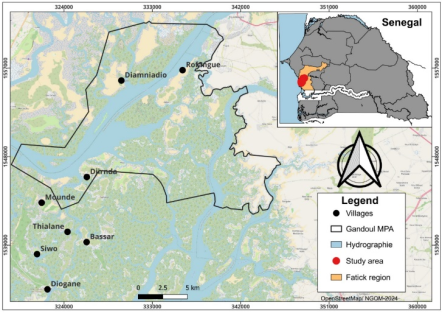
Figure 1. Map showing the location of the Gandoul MPA and its surrounding area.
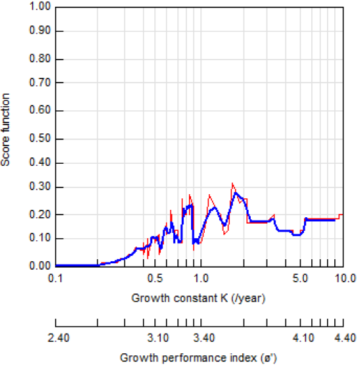
Figure 2. Growth performance index of S. senilis in the Gandoul MPA and its periphery.
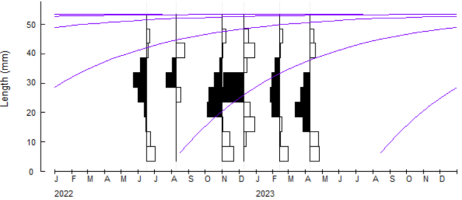
Figure 3. Restructured length frequency distribution with superimposed growth curves for S. senilis in the Gandoul MPA and its periphery (dark bars=actual frequency bars, white bars=reconstructed bars).
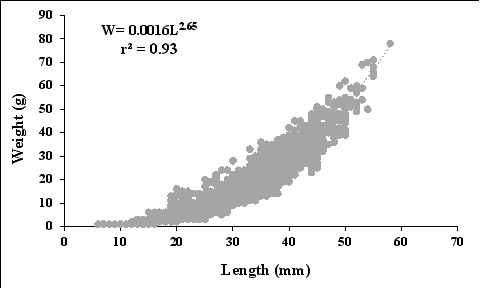
Figure 4. Length-weight relationship of S. senilis in the Gandoul MPA and its periphery.
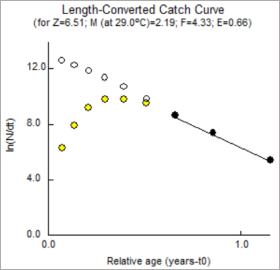
Figure 5. Length-converted catch curve of S. senilis in the Gandoul MPA and its periphery (yellow dots are dots used in calculation and white dots are dot not used in calculations).
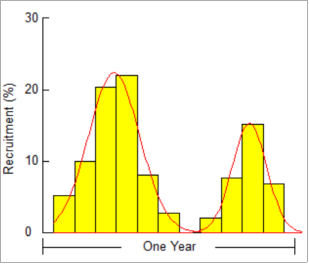
Figure 6. S. senilis biannual recruitment model in the Gandoul MPA and its periphery.
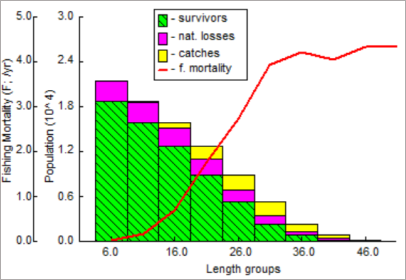
Figure 7. Virtual population analysis of S. senilis in the Gandoul MPA and its surrounding area.
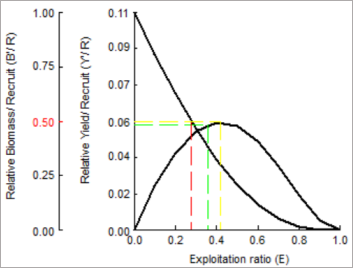
Figure 8. Relative yield per recruit, relative biomass per recruit and exploitation rates of S. senilis in the Gandoul MPA and its periphery (red dashes=E0.1, green dashes=E0.5 and yellow dashes=Emax).

Information



 Share This Article
 Twitter
 Linked In
 Facebook
 Copy
Copy Download